
By Gloriah Kamwamu
We’d been saying it for months—“We“ have to go to Kit Mikayi.” You know how it is: life gets in the way, time slips by, and before you know it, a year in Kisumu has flown. With my internship wrapping up and Jill juggling a whirlwind of work lately, we figured—it’s time. Time to breathe. Time to unwind. Time to finally tick that box.
So, on a bright Saturday morning, we hit the road. Jill’s behind the wheel (as usual, the most trusted pilot), and we’ve got Dama with us—third wheel by title, but honorary adventurer by spirit. The roads are kind to us—smooth stretches, sun-dappled skies, and detours whenever we spot something too beautiful to just pass by. One view after another—some we commit to memory, others get immortalized on camera. We’re those people today, and we love it.
As we bump down the rough road leading to Kit Mikayi, excitement builds. The air feels heavier, like it’s holding stories. Sacred ground. Echoes of ancestors. A place that doesn’t just exist—it speaks. Thankfully, it’s well-marked. No room for getting lost—at least not physically.
We park and are ushered into a clean, modern open building to sort out the entrance fees (shrine revenue must be managed, after all). Then comes our guide: a lean, seasoned man whose steps know this place like muscle memory. He’s walked these paths countless times. His body shows it—fit from the climbs; his voice shows it too—wise from retelling tales that never grow old.
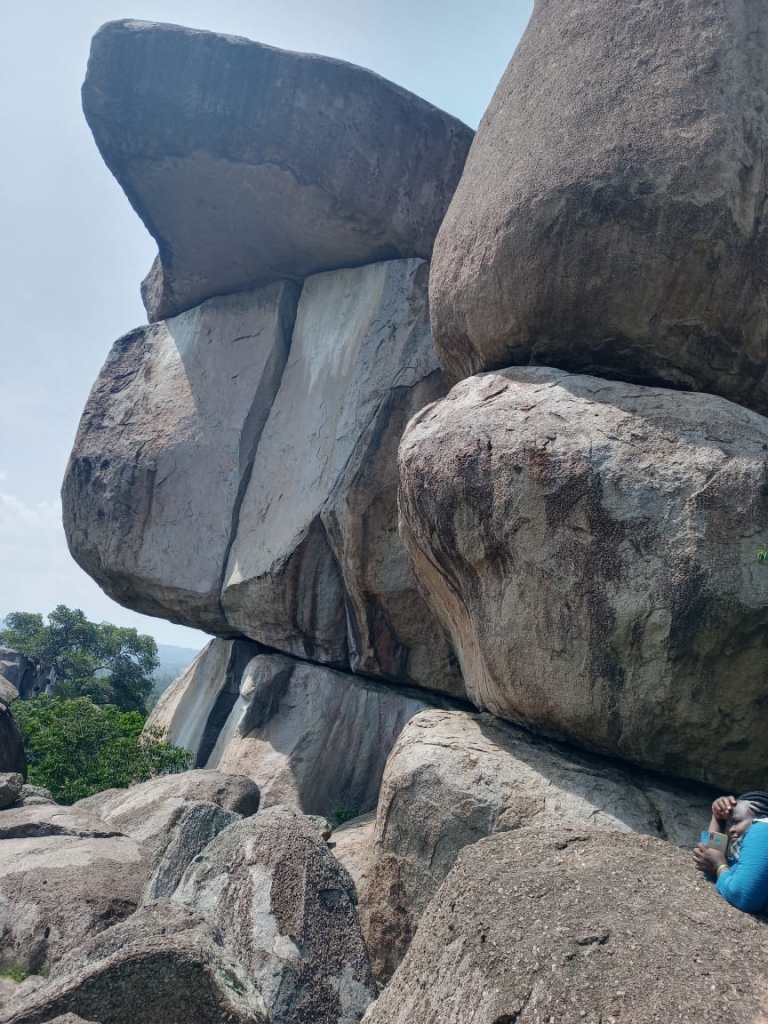
At what feels like the cave entrance, he begins. This isn’t just a rock—it’s Kit Mikayi, the “Stone of the First Wife.” Legend tells of a Luo elder who found such peace and connection at this site that he came here daily to pray and meditate. So faithful was he, the community said the rock had become his “first wife.” A name. A story. A culture, layered into stone.
We step into the shadows of the rock, and the atmosphere shifts. Our guide tells us about the sacred rituals, the prayers for rain and harvest, the seekers of healing and peace. He leads us into a space where the elder once sat. It’s shaped almost like a room—complete with a stool carved straight from the rock. We take turns sitting on it. It feels still and grounding, like the rock is listening back.

From there, the journey turns upward. Our guide, spry and sure-footed, leads us up the rock. With each step, the view expands. The land spills out below us—green, alive, dotted with homesteads and distant hills. Lake Victoria glints far off like a secret whispered in light. There’s even a tree, growing defiantly through the rock, twisting and reaching for the sun. Nature’s metaphor in full display.
We linger at the top. Take it in. Say little. It’s the kind of view that hushes you into awe.
Eventually, we begin the descent—on a different path this time. The route loops us back to where we began, but before we can even process the full circle we’ve just made, we’re met by women in traditional dance attire. They insist—politely but firmly—that we don’t just watch. No, no. We must dance too. Suddenly, we’re in full costume, moving to the rhythm of drums and ululations, laughing, breathless, thrilled. It’s the perfect ending—a celebration, not a conclusion.
Visiting Kit Mikayi isn’t just sightseeing—it’s a soul stop. A quiet immersion into history, belief, and nature’s raw grace. It reminds you where you are, who came before, and how some places speak louder in silence.
As we drive away, a gentle hush settles over the car. Not sadness—just that good kind of nostalgia. We don’t even need to say it, but Jill does anyway:
“We’re definitely doing this again.”


 Waiting Differently
Leave a comment